

2026 Ward 2 Family ECO Fest
What an incredible day!
A heartfelt thank you to everyone who helped make the 3rd Annual ECO Family Fest such a tremendous success. From the many dignitaries who joined us in support of the event, to our volunteers, entertainers, exhibitors, businesses, environmental organizations, sponsors, and community partners. This event would not have been possible without your enthusiasm, commitment, and hard work.
Most importantly, thank you to the thousand plus residents who came out to learn more about sustainability, innovation, environmental education, active transportation, clean technology, and practical climate solutions. Your participation demonstrates that our community is eager to explore ways we can all work together to build a more sustainable future.
One of the things that makes ECO Family Fest so special is the opportunity it creates for people to discover new ideas, ask questions, try something different, and leave with a greater understanding of how individual actions can collectively make a meaningful difference.
And of course, a special thank you to Mother Nature, who once again blessed us with remarkable weather. After three straight years of sunshine, I am beginning to think she approves of the message we are helping deliver on her behalf!
Thank you to everyone who joined us and helped make this year's event one to remember. Together, we are proving that sustainability, innovation, and community go hand in hand.

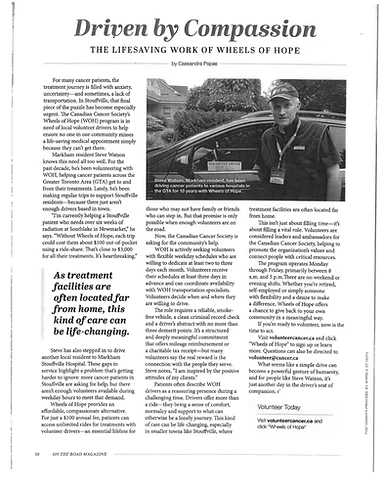
The Canadian Cancer Society’s Wheels of Hope program is looking for more volunteer drivers to help residents in your community.If you, or someone you know, is looking to fill some time in your day, love to drive and want to support people with cancer, we encourage you to volunteer with Wheels of Hope.
As a volunteer driver, you can give the gift of a ride to people with cancer who need help getting to and from their life-saving cancer treatments and other appointments. Mileage reimbursement or tax receipt is provided. Visit www.volunteercancer.ca and click on Wheels of Hope. For more information, please email at volunteer@cancer.ca
Richmond Hill City Council Passes the Plant Based Treaty Motion
Read Councillor Thompson's BLOG





How To Shop Canadian
Following the U.S. threat of tariffs, Canadians have taken to showing their support for the true north, strong and free. I hear from people that they want to feel confident that their hard earned dollars are making the greatest possible impact on the Canadian economy. The difficulty is recognizing how “Canadian” a product is.
I hope that you find the following information useful.
When you are at the store, you’ll want to look for the following labels:
-
"LOCAL" – Means the product was produced and sold in the same province or across provincial borders within 50 kilometres of the originating province or territory
-
"100 PER CENT CANADIAN" – means that all of the ingredients, processing and labour used to make it is all Canadian or located in Canada.
-
"PRODUCT OF CANADA" – Means that all of its major ingredients, where it was processed, and the labour used to produce it are Canadian or are located in Canada (could contain less than 2% non-Canadian ingredients and still be considered “product of Canada”)
-
"MADE IN CANADA" – Means just that. The product was last processed or had its “last substantial transformation” in Canada but may be a mix of both domestic and imported ingredients. (May sometimes be labelled “proudly made in Canada”)
If a product is labelled as being “Canadian,” that is considered the same as the “product of Canada” label.
Here are some other labels to look for:
-
"ROASTED AND BLENDED IN CANADA" - to describe coffee since the coffee beans are always imported.
-
"DISTILLED IN CANADA" - to describe bottled water that was distilled in Canada.
-
"CANNED IN CANADA" - to describe green beans that were canned in Canada.
-
"REFINED IN CANADA" - to describe imported cane sugar which has been refined in Canada.
-
"PROCESSED IN CANADA" - to describe a food which has been entirely processed in Canada.
-
"PREPARED IN CANADA" - to describe a food which has been entirely prepared in Canada.
-
"PACKAGED IN CANADA" - to describe a food which is imported in bulk and packaged in Canada.
Good to know:
Wild fish and seafood products can be labelled Product of Canada when caught by vessels in Canadian waters (or adjacent waters as per Canadian regulatory fishing quotas) and the products from the fish and seafood are processed in a Canadian establishment using Canadian ingredients.
In the case of farmed fish and seafood, the farm must be located in Canada, and the processing must occur in a Canadian establishment with the use of Canadian ingredients.
The Canada Organic logo is an indication of organic certification to the Safe Food for Canadians Regulations. On imported products that are qualified to use the Canada organic logo, a country-of-origin statement or the statement "Imported" is required to be in close proximity to the logo, to avoid misleading consumers.
Finally, if you are looking for information on your typical everyday grocery items, then I recommend that you visit the Made in CA website.